The Somatic School's Origin Story
The Somatic School didn’t begin with a business plan.
It emerged through years of following these questions:
- What would coaching look like if we took the wisdom of the body as seriously as the thinking mind?
- What if we returned sense-making to the senses?
These were questions about the body at first. Following them would eventually lead into questions about:
- how people change
- what allows change to emerge, and
- the orientation we bring to the process itself.
For Founder Nathan Blair, that curiosity had been forming for years.
This article is the story of how The Somatic School came to be and why we have come to believe that somatic depth and professional rigour belong together.
The Somatic School is a somatic coach training school founded by Nathan Blair, offering ICF-accredited training in Body-Oriented Coaching.
A Community of Practice
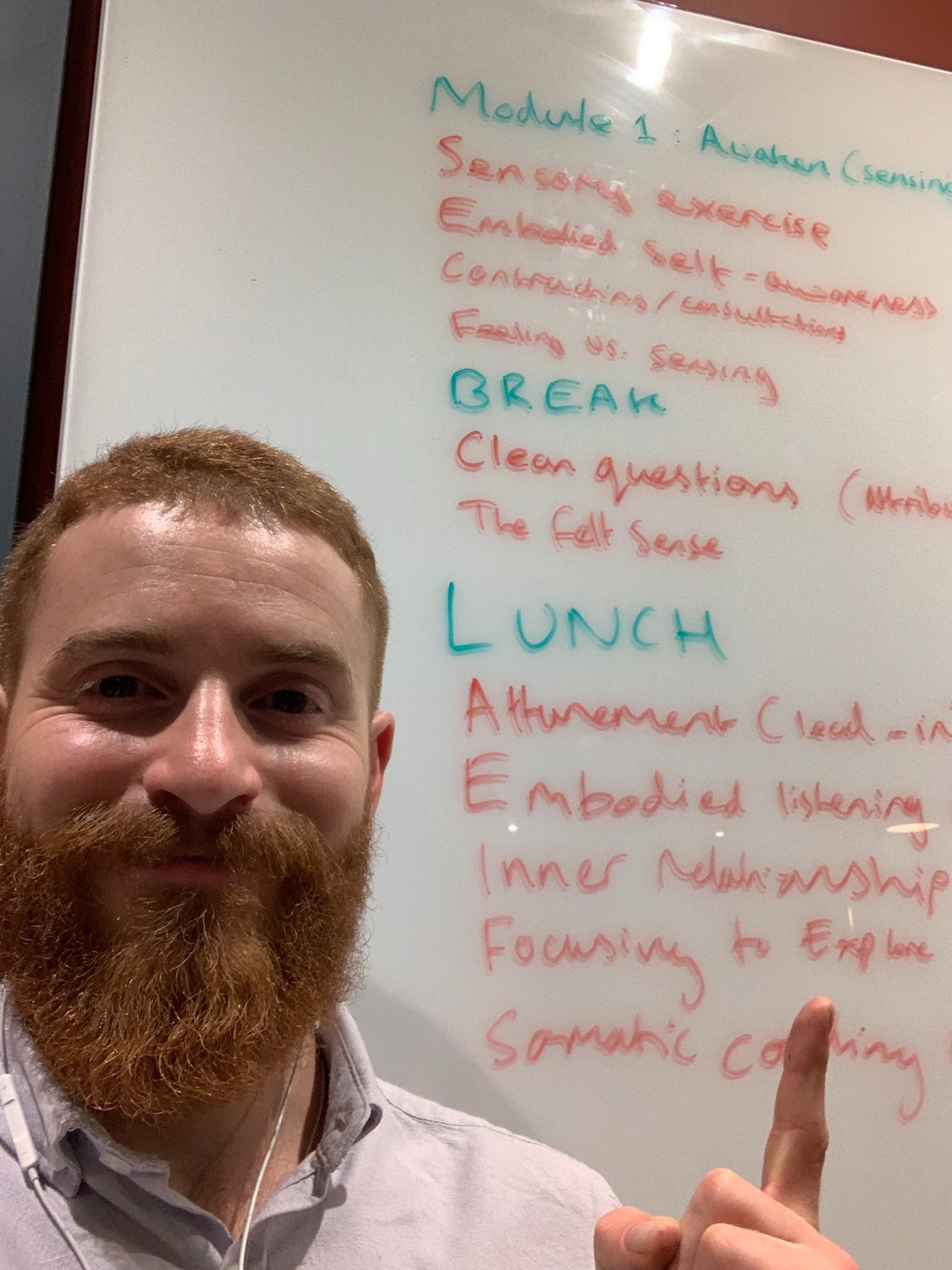
Fresh out of university with a degree in psychology, Nathan found himself working in leadership development, surrounded by executive coaches and conversations about growth, change, and human potential.
Until then, he had assumed that helping people meant becoming a psychotherapist. Coaching revealed a different possibility.
It wasn’t focused on diagnosis or pathology. It was oriented toward growth, possibility, and what is yet to come. It resonated with something he already sensed.
“People didn’t necessarily need someone else to provide the answers. They needed relationships in which something more could become available.” Nathan Blair
People didn’t necessarily need someone else to provide the answers. They needed relationships in which something more could become available.
As his coaching career developed, Nathan became increasingly interested not only in coaching, but in how coaches learn.
Working within a coaching school, he designed programmes, developed curriculum, recruited faculty, and created learning experiences for practitioners.
He began to notice that meaningful education was about far more than transferring information.
The intentions of the facilitator matter. The nature of the conversation matters. The learning environment matters. So did the relationships between people in the room.
People learned differently when they were invited into a community of practice rather than simply given knowledge to consume.
Long before The Somatic School existed, some of its foundations were already taking shape.
But one question kept pulling at Nathan’s attention.
What about the body?
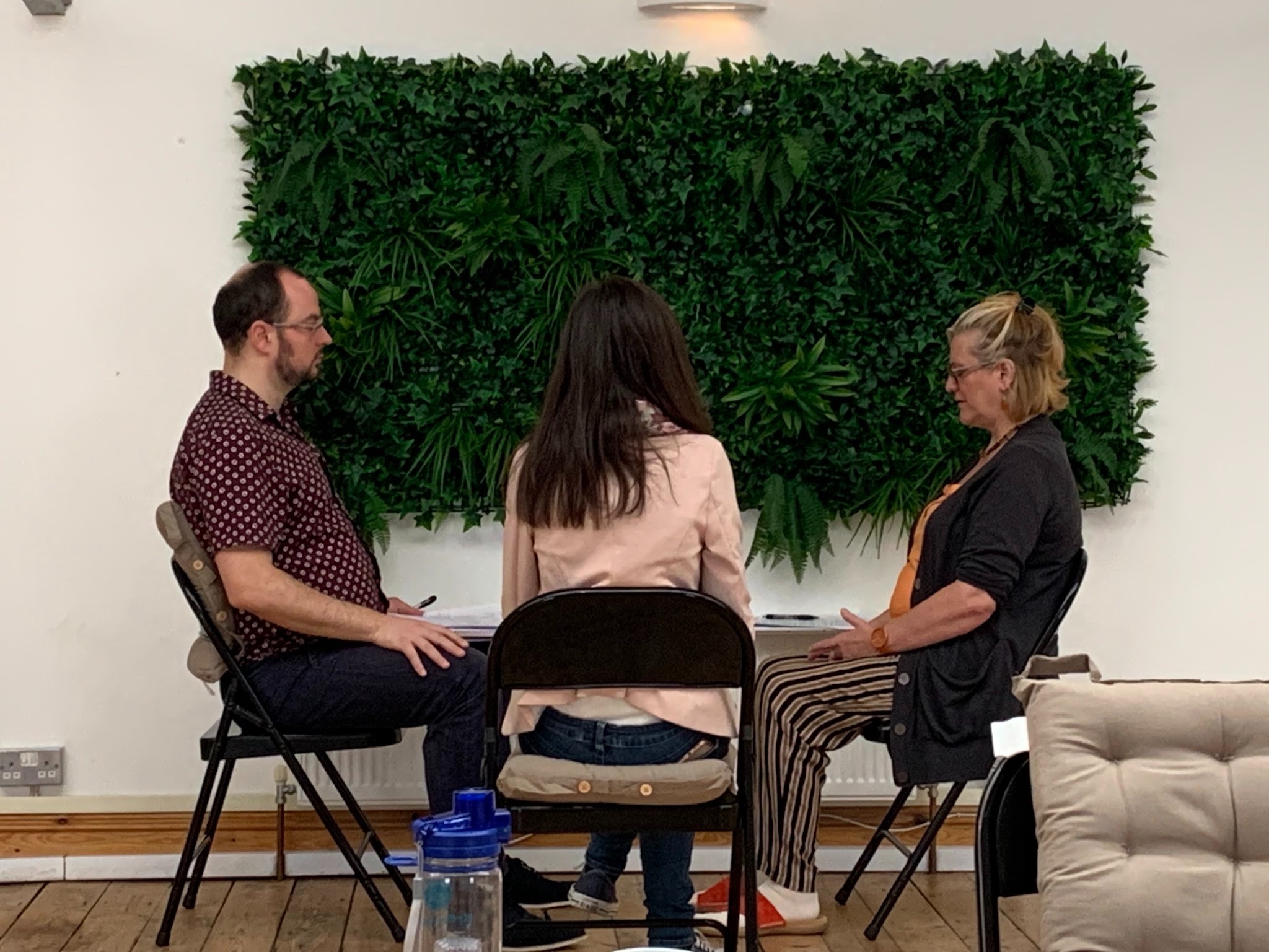
Again and again, some of the most important moments in coaching seemed to live beneath the words.
A change in posture. A tone shift. A hesitation. A feeling that couldn’t yet be described.
The body was communicating, yet much of professional coaching offered little guidance for how to work skilfully with what it was saying.
Unable to find the somatic coaching training he was looking for, Nathan followed the question himself.
It led him back towards a path he had set aside years earlier and into training as a body psychotherapist. He immersed himself in process-oriented traditions including Focusing, Hakomi, Gestalt, and Authentic Movement, alongside interpersonal neurobiology, embodied cognition, humanistic psychology and the science of living systems.
What he found did not feel like a rejection of coaching.
It felt like a deepening of coaching.
These approaches were client-centred and non-prescriptive, led by what the person brought rather than what the practitioner prescribed.
They expanded what could be included in the work: sensation, emotion, movement, relationship, and experiences that had not yet found words.
Beneath the different practices, Nathan recognised something he deeply valued: trust in the person and in the process itself.
Gradually, what began as curiosity became conviction.
“The body wasn’t another tool to add to coaching. It was a missing dimension of how we understand human development.” Nathan Blair
Many coaches were looking for the same training Nathan had been seeking. And they weren't the only ones.
Practitioners, leaders, helpers, and lifelong learners were beginning to ask similar questions.
- How do people actually change?
- What role does the body play?
- What becomes possible when we work with the whole person, not just the thinking mind alone?
There were places to study coaching and places to study the body, but few brought the two together in a way that held both professional rigour and genuine somatic depth.
The Somatic School emerged in that space giving people a place where they could develop the skill, understanding, and presence required to work with the whole bodymind.
This approach became known as Body-Oriented Coaching.
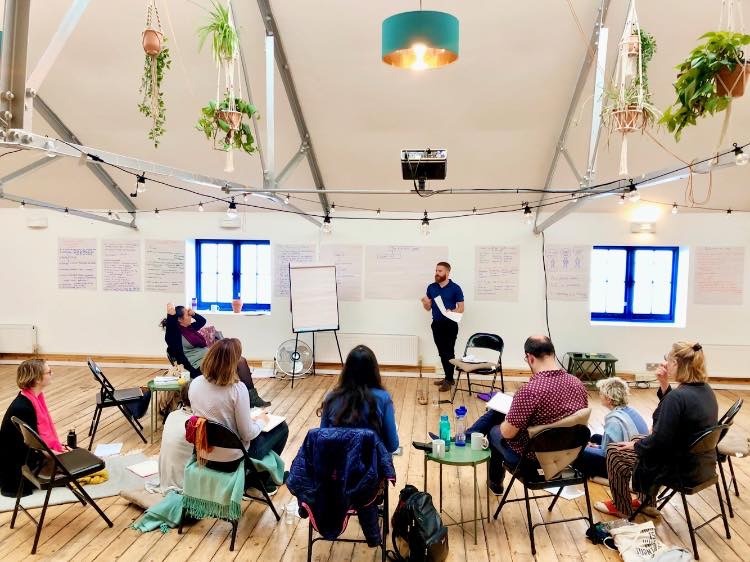
A community began forming around the work.
People who had sensed something missing in conventional approaches found language, practice, and one another.
In time, these community members would become known as the Somanauts.
Somatic depth meets professional rigour
Over time, the programmes grew. The methodology matured.
In 2022, The Somatic School became the first somatic coach training provider in the world to receive the prestigious ICF Level 2 accreditation.
It was an important recognition of something the school had been committed to from the beginning:
doing this work well did not mean choosing between somatic depth and professional rigour. It required both.
Finding a philosophy for what was already there
Nathan had been arriving at similar ideas from seemingly different directions: the interconnectedness and effortless unfolding of Eastern philosophy; traditions that understood God is love; the humanistic tradition and its trust in the actualising tendency of the individual; and years of training in process-oriented body psychotherapies.
In early 2023, Nathan encountered Process Philosophy for the first time.
What he found was startlingly familiar: the idea that reality is composed not of static things but of happenings; that the world exists in continuous becoming; that providence moves through loving persuasion rather than control.
“Process Philosophy did not change the direction of The Somatic School. It gave language to something that had been shaping the work from the beginning. It revealed the organising principle beneath it all.” Nathan Blair
That recognition also brought a larger question into focus.
What if the people seeking “growth,” “healing,” and “transformation” were never broken in the first place?

Much of personal development begins with some version of the opposite assumption: identify the problem, overcome the obstacle, fix what is holding you back, become a better version of yourself.
This approach has helped countless people.
But it can also turn growth into an endless project of self-correction, where every difficulty becomes evidence that there is still something wrong.
The Somatic School had been observing something different.
The Team could see practitioners working with many of the same skills, techniques, and process-oriented approaches, yet producing very different results.
What accounted for the difference?
What did some practitioners understand, consciously or otherwise, that allowed for meaningful change to emerge?
The answer didn’t seem to be simply another skill or technique.
Something deeper seemed to be shaping how the work was understood and practiced.
Meaningful change seemed to emerge not when people overrode more of their experience, but when more of that experience was allowed into the conversation.
Not when resistance was overcome and change was forced, but when people developed a different relationship with what was already here and unfolding.
Grace Unfolding
Over time, these observations, practices, and influences found a more coherent expression in the worldview The Somatic School calls Grace Unfolding:
The recognition that life is already in motion, that human beings are participants within that movement, and that generative change emerges through relationship, attention, and participation rather than force.
Grace Unfolding is the worldview that now sits at the heart of The Somatic School’s approach to somatic coaching and human development.
In that sense, the articulation of Grace Unfolding brought greater coherence to what had been circling within The Somatic School all along.
It is the implicit made explicit: a worldview shaped through years of learning, practice, experience, and curiosity finally finding its language.
The Somatic School Today
Today, The Somatic School sits at the intersection of professional coaching, somatic practice, and that broader philosophy of human development.
What began as an effort to bring the body more fully into coaching has become a school, a community, and an evolving body of work exploring a larger possibility:
What changes when we stop treating human beings as isolated problems to solve and begin meeting them as participants in a living whole?
The work continues to unfold from there.